

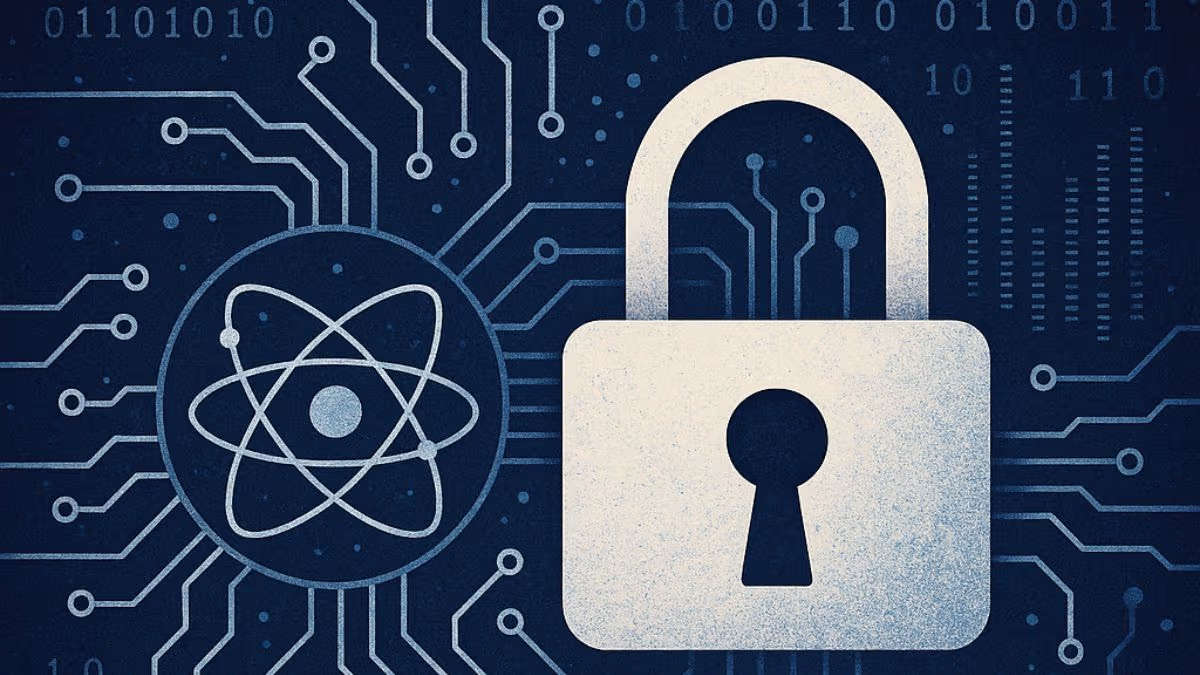
Australia Faces a Quantum Turning Point in Cybersecurity
Australia is standing at the brink of a technological shift that could redefine cyber resilience for decades to come. With quantum computing rapidly advancing, the foundations of today’s data security are becoming increasingly fragile. While quantum technology promises powerful breakthroughs in medical research, logistics, and artificial intelligence, it also carries a significant threat: the ability to break the cryptographic systems that protect government, business, and personal data.
Quantum computers harness the principles of quantum mechanics by using qubits—units that can exist in multiple states simultaneously—unlike traditional computers that operate only on binary 0s and 1s. This exponential computational power allows quantum machines to solve complex mathematical challenges that classical systems cannot feasibly handle.
One of the most alarming implications is the ability to break widely used public key encryption standards such as RSA and ECC (elliptic-curve cryptography). Once large-scale quantum computers become available, these encryption mechanisms—currently securing nearly all digital communications—could be compromised in hours, not decades.
Why Post-Quantum Cryptography Is Now a National Priority
The Australian Government has already identified post-quantum cryptography (PQC) as a key priority in its 2023–2030 Cyber Security Strategy. A major mindset shift it promotes is treating data longevity as a core component of classification. Instead of only asking “How sensitive is this data?”, organisations must now also ask, “How long does this data need to remain secure?”
Data requiring confidentiality for 10–30 years—such as medical records, intellectual property, defence information, and critical infrastructure designs—is now among the most at-risk. The potential exposure of these assets threatens financial stability, operational continuity, and national security.
Why PQC Matters
Traditional cryptography relies on the difficulty of mathematical problems that classical computers cannot solve efficiently. RSA depends on the difficulty of factoring large numbers; ECC relies on the discrete logarithm problem. Quantum computers, through Shor’s algorithm, can solve both with unprecedented speed, undermining the protections we rely on today.
Importantly, post-quantum cryptography is not the same as quantum cryptography. PQC refers to quantum-resistant algorithms that run on normal computers but are designed to withstand quantum attacks.
A common misconception is that quantum threats are “too far away to matter.” This mindset exposes organisations to “harvest now, decrypt later” attacks, where adversaries collect encrypted data today with the intention of decrypting it once quantum capability arrives.
Implementing PQC early delivers several advantages:
Long-term protection of sensitive data
Readiness for emerging compliance requirements
Reduced future migration costs
Enhanced customer, partner, and investor trust
Greater business continuity in an evolving threat landscape
Join the Discussion
0 Comments
No comments yet. Be the first to comment!